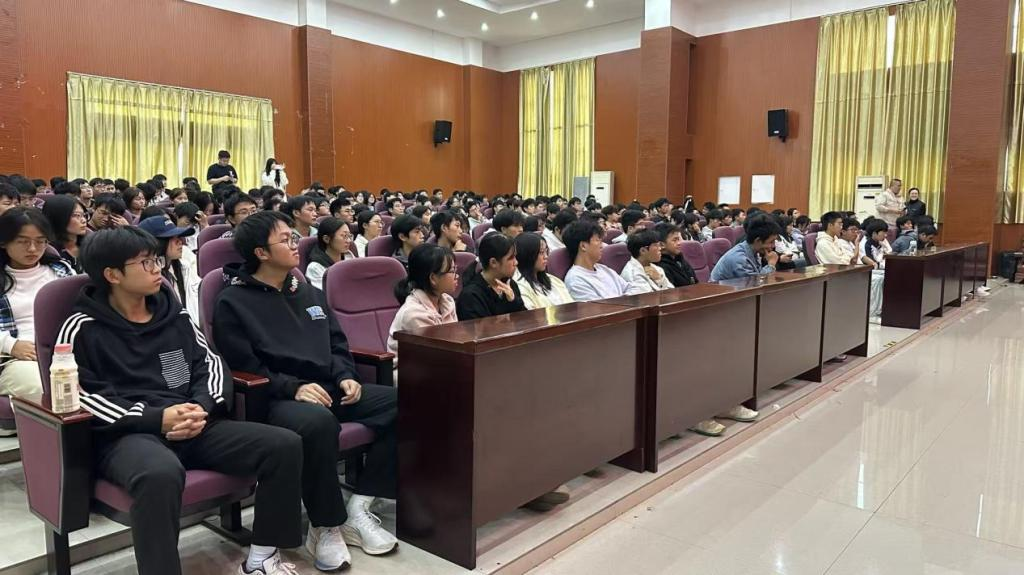
Net News (Text/Fan Yaxin, Photos/Bai Chenyang) On the afternoon of October 28, the School of Software Engineering held an anti-fraud awareness session for its 2025 freshman cohort in the Lecture Hall of Building No. 1. The event featured a special lecture by Officer Wan Kefei from the Jiaoqiao Police Station of the Economic and Technological Development Zone Public Security Bureau, aiming to enhance freshmen’s awareness of fraud prevention and safeguard their financial security.

During the lecture, Wan Kefei addressed the current state of telecom fraud and the necessity of anti-fraud awareness campaigns. He delivered an in-depth presentation centered on four key anti-fraud messaging pillars: “Do not participate in telecom or online fraud,” “Avoid being exploited by fraudsters,” “Prevent yourself from becoming a victim of telecom or online fraud,” and “Do not tolerate telecom or online fraud.” He systematically explained the severe harms of telecom fraud and underscored the importance of cultivating proactive fraud-prevention awareness.
Wan particularly focused on types of telecom fraud recently prevalent among university students, illustrating common scam tactics through multiple real-life cases:
In secondhand transaction scams, fraudsters lure victims with “discounted items,” persuade them to move conversations off legitimate platforms onto WeChat, and then send counterfeit payment links mimicking real e-commerce sites. Once the victim transfers money, they are immediately blocked.
In logistics/customer service scams, perpetrators use victims’ actual shopping and delivery information to pose as customer representatives, claiming the purchased item was “lost or damaged” and offering “10x compensation.” They then gradually request payments such as a “logistics deposit.”
In impersonation of law enforcement scams, fraudsters obtain personal data through fake platforms and pose as police or judicial officers, demanding victims pay a so-called “case-handling deposit.
Investment scams entice users with small initial profits; once victims increase their investment, the scammers disappear with the funds.
Additionally, illegal scams involving online solicitation for prostitution or “naked chat” extortion often coerce victims into paying “deposits” or extort money by threatening to leak private content.
Wan emphasized that modern fraud syndicates possess significant technical capabilities—they can create highly convincing fake links and web pages and tailor their scams based on a victim’s spending power and bank balances. He urged incoming freshmen to adopt a mindset of “proactive fraud recognition”:
· Never be tempted by unrealistically low prices—always complete payments through official platforms;
· Never blindly trust unknown customer service representatives—verify any requests involving “deposits” or “compensation” through multiple reliable channels;
· Never succumb to fabricated threats—if targeted in a “naked chat” scam, block the sender immediately and never transfer money;
· When encountering suspicious messages, always ask “Why?” and promptly consult campus security or local police.
This lecture, enriched with authentic case studies and practical advice, significantly deepened the 2025 cohort’s understanding of common telecom and online fraud tactics and effectively strengthened their ability to recognize and resist scams—laying a solid foundation for building a safe and secure campus environment.
(Edited /Fan Yaxin; Preliminary Review /Wu Shaojie; Secondary Review /Fang Yating; Final Review /Lan Xinhua)